



A Washington Post opinion piece says American Christianity may actually be flourishing. The data tells a much stranger story.
The Pledge
Byron Johnson and Thomas Kidd writing an opinion piece for the Washington Post's "Awakenings" newsletter (alas, paywalled) do their best to make the accelerated decline of institutional American Christianity magically disappear:
One of the most persistent news stories about religion in recent years has been the decline of Christianity and the rise of the “nones,” or people who have no religion in particular. The nones narrative suggests that American Christianity is in free fall. One headline in recent weeks announced that even young Latinos, part of what is often regarded as one of the most religious ethnic groups, are “abandoning churches to be ‘nones.’” Look closer, however, and you can find data suggesting that Christianity is flourishing.
The authors address an important issue. Popular discourse on the nones tends to obscure more than it reveals. As a group, the nones are so religiously diverse that its usefulness as an analytical category is largely limited to illustrating that religiosity in the U.S. is changing. To their credit, this is the opening pledge of their piece, and I agree with many of their points:
- The phenomenon of "nones" tends to be equated with the modern narratives of religious decline when the reality is more complicated.
- Being religiously unaffiliated doesn't necessarily make one non-religious, non-theist, or even non-Christian.
- We need significantly more nuanced discourse (and I would add, lots more empirical research) to better understand what is going on.
But none of these are Johnson and Kidd's central claim. Instead, they dangle a much more surprising thesis: Despite all evidence to the contrary, "Christianity is...flourishing."
Well now, that is surprising. Tell us more!
Some signs indicate that young American men are attending church more than they did in previous generations. High-profile intellectuals such as Ayaan Hirsi Ali, who was one of the leading figures of the New Atheist movement, have publicly announced their conversion to Christianity. And even the Pew Research Center, a chief promoter of the nones story, has admitted that the nones have plateaued at less than 30 percent of respondents.
What is really happening? Rather than experiencing simple growth or decline, American religion is in a state of churn. Some sectors are falling fast, while others show phenomenal growth.
Interesting. But which sectors show phenomenal growth and which are falling fast? If we jump to their conclusion, we see this:
So, yes, progressive denominations are in a virtual state of collapse. Nominal religiosity is becoming a thing of the past. But evangelical, Pentecostal and immigrant-focused nondenominational ministries are rallying from behind.
Ah. So the nones can be attributed to Mainline Protestant decline (which, they incorrectly label "progressive")[1] but that is being counteracted by the "phenomenal growth" of covert Evangelical and Pentecostal churches in the U.S.
In other words, it's all an illusion folks. Christianity isn't declining, it's just changing. This is fine.
The Turn
Give the authors credit for making 75 million adult Americans (that is, the nones) disappear. John Cutter would be proud.
But I remain skeptical.
First, the "men are returning to church" story has been convincingly debunked.[2] Second, a few public intellectuals converting to Christianity is very interesting, but it's hardly evidence of institutional flourishing. Moreover, the authors cherry-picked arguably the most virtuous example in Ayaan Hirsi Ali. Other high profile conversions are...more problematic.[3]
More quantitatively, it's odd to cite the recent plateau of the "nones" as evidence of Christianity's flourishing. It's certainly possible this is evidence that Christianity is reversing thirty years of accelerated decline. It's also possible this will turn out to be just another cyclical fluctuation, like earlier ones we can observe by glancing at a line chart of the percentage of nones in the U.S. since the General Social Survey started asking about religious affiliation in 1972.
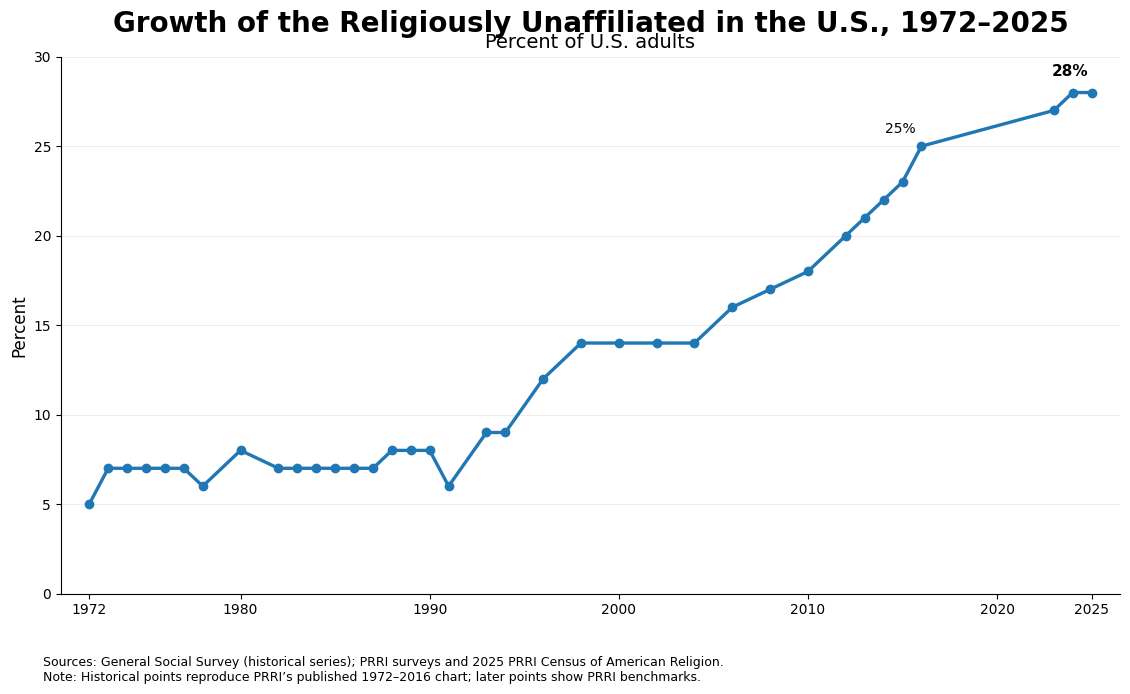
Given this, what seems more likely to you:
- a) The plateau between 2023 and 2025 is evidence of institutional Christianity's resurgence, or,
- b) The percentage of nones has entered another non-growth cycle, similar to those observed from the mid-to-late 1970s, the early-to-late 1980s, and the late-to-mid 2000s?[4]
This illustrates a concern I have with Johnson and Kidd's piece: in an article promising to "look closely" at the data, it glosses over so much.
The claim, for example, that some sectors of Christianity in the U.S. are showing "phenomenal growth" is never substantiated. The authors cite one study that conjectures (but does not establish) that the U.S. Religion Census undercounts churches by 25%, especially among new movements, congregations of color, and immigrant congregations. That's certainly possible. But even if it's true, that does not equate to phenomenal growth among undercounted churches. At best, it demonstrates a gap in the research (which is precisely the conclusion of the study they cite).
Similarly, the authors cite dramatic growth of church plants in Boston between the 1960s and early 2000s. Again, this cannot be claimed as evidence of growth in any sector today. Twenty-six years later, what has happened with these congregations? How many still exist? Are they growing or declining?
Church planting was an active movement in the U.S. between the 1980s and 2010s, largely among Evangelical denominations. However, according to Lifeway Research, by 2019 church plants were no longer keeping pace with church closures.
And even if there are large numbers of uncounted church plants in the U.S., more churches do not mean more Christians. The U.S. had about 2.2% more congregations in 2020 than it did in 2010. That sounds positive until you remember the U.S. population grew by 7.4% during that period while, at the same time, congregational size decreased by 53%.
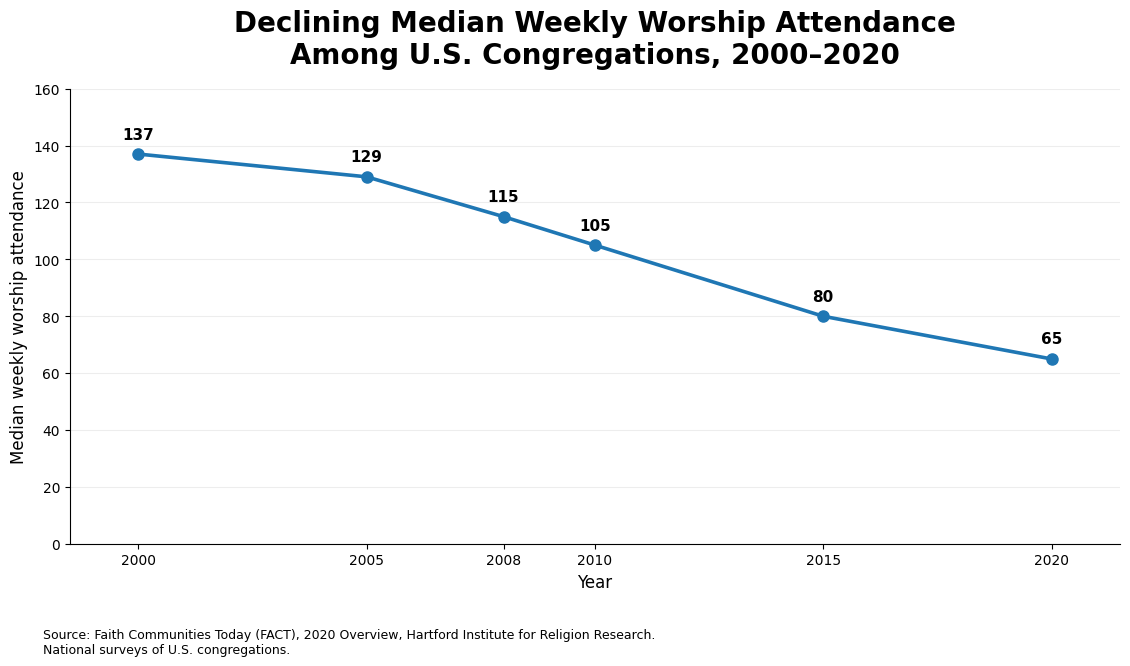
At this point, you may be wondering: If they're right that invisible sectors of of Christianity are growing phenomenally, what accounts for the dramatic decline of the last 50 years? This is where Johnson and Kidd point to Mainline Protestantism.
So, yes, progressive denominations are in a virtual state of collapse. Nominal religiosity is becoming a thing of the past. But evangelical, Pentecostal and immigrant-focused nondenominational ministries are rallying from behind. This helps explain why the growth of the nones has come to a stop. American religion is changing fast. That’s the way it’s always been in America’s dynamic spiritual marketplace.
Don't get me wrong, Mainline Protestant Christianity is in serious trouble. I'll have more to say about that in future posts, because as a former Evangelical-turned-Mainline pastor, I think we are still not facing reality. But to lay the decline of institutional Christianity writ large at the feet of Mainline Protestantism is to, again, gloss over the data.
For example, here's a chart tracking the membership of the Southern Baptist Convention:
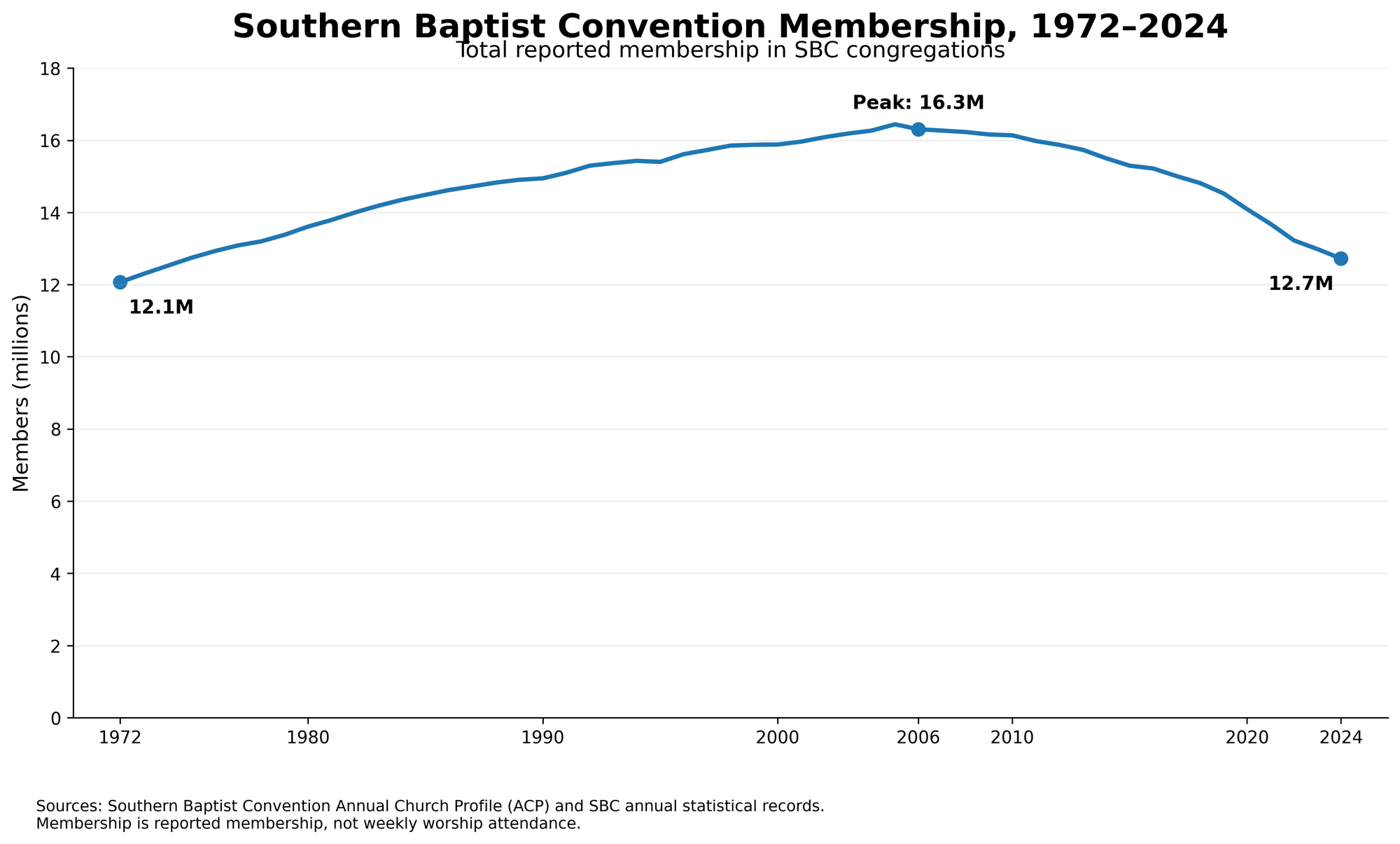
Given that over the last 20 years the single largest Evangelical denomination in the U.S. is also experiencing rapid decline, it doesn't seem likely that Americans are simply switching from liberal to conservative expressions of religion. You could reasonably argue that is exactly what was happening between the mid-1970s and the mid-1990s. But something has changed since then. Indeed, this is one of the biggest weaknesses in Johnson and Kidd's theory.
As we can see, the growth of the nones has not been steady. There have been plateaus, dips, and peaks before now. Specifically, the nones surged dramatically in the mid-1990s and again in the mid-2010s. Research has correlated these surges with backlash against right-wing Christian political rhetoric on issues like abortion, LGBTQ rights, and immigration. And these are many of the same reasons nones give for disaffiliating when asked in surveys.
Moreover, this is not an exclusively Protestant phenomenon. Catholics have declined by population share from 25% to 19%, despite being buoyed significantly by immigration.[5]. Here's the data overlaying all four categories (Mainline, Evangelical, Catholic, and Nones) since 1972.
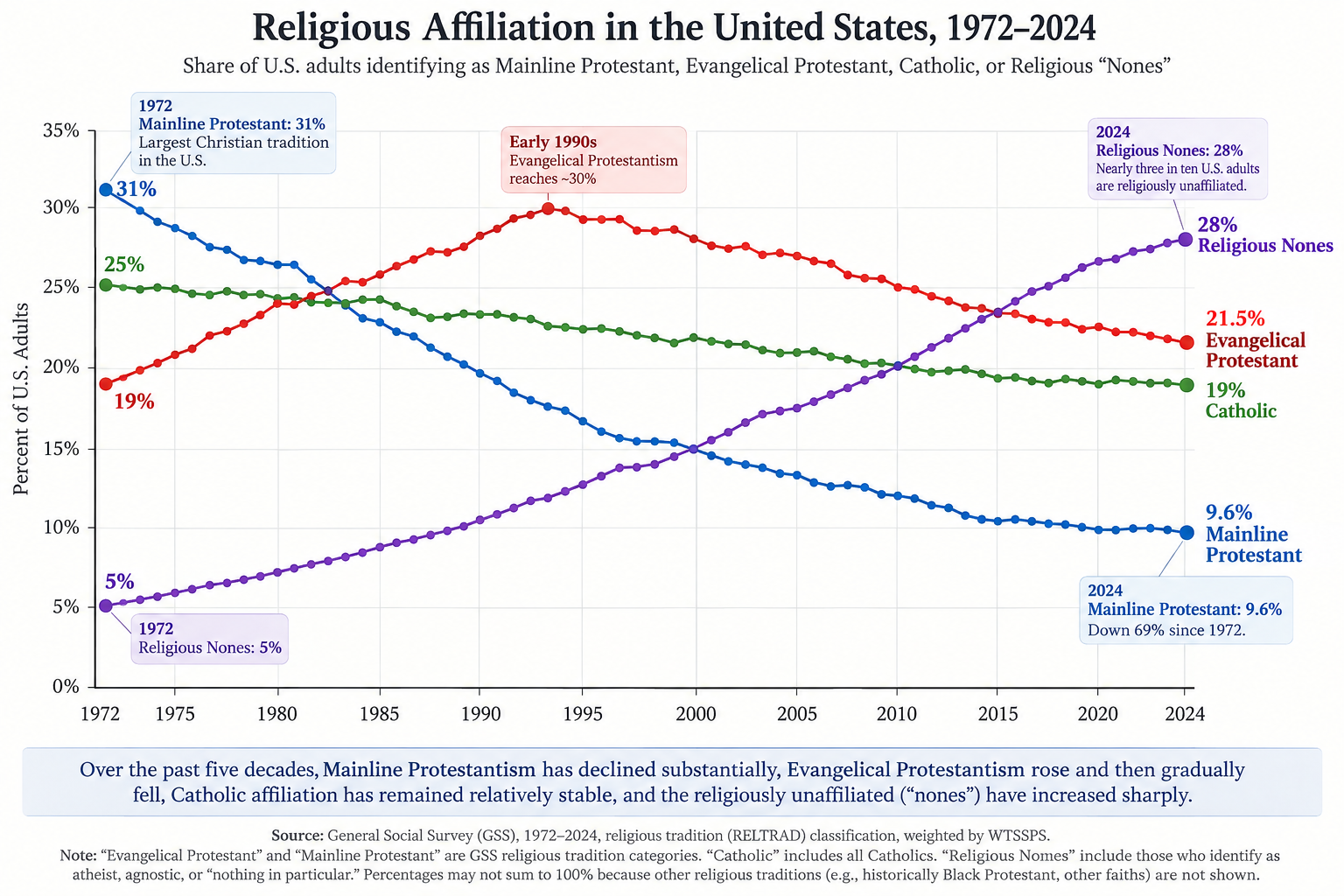
So, to summarize:
- National survey data shows every major Christian tradition has declined by population share since 1972.
- People who do not identify with any institutional religious identity have increased from 5% of the population in 1972 to 28% in 2024.
- Prominent reasons for disaffiliation given by respondents are loss of belief and disagreement with the right-wing social and political teachings of the church.
- That decline appears to have levelled off in the last few years.
The Prestige
Given the data, it seems to me that for Johnson and Kidd to be correct, two unlikely things must be true:
- Undercounted congregations primarily made up of immigrants and people of color would have to contain enough adherents to substantially alter the national picture.
- Those populations would have to be experiencing sufficiently rapid net growth to offset losses elsewhere.
The available data simply doesn't show that. Pew surveys include Black, Hispanic, Asian and immigrant respondents and long-term institutional Christian decline appears across racial and ethnic groups. Among immigrants specifically, Christianity fell from 75% in 2007 to 58% in 2023–24 while unaffiliated identification increased from 16% to 26%.
So then, what is happening to American religiosity?
As I mentioned, the nones certainly are evidence of a dramatically changing religious landscape. But I disagree that American Christianity is essentially swapping liberal Mainline Protestantism for Evangelical/Pentecostalism.
Nor do I think the U.S. is simply undergoing a similar, albeit delayed, process of secularization akin to that experienced in Europe a century ago. Americans by and large have not become disenchanted atheists and agnostics. As Johnson and Kidd rightly point out, even the majority of nones report some form of spiritual belief and the relative percentage of atheists and agnostics have remained stable over the decades.
To know what's going on we desperately need more empirical research into the actual lived religion of unaffiliated Americans. That's hard to do because this is an incredibly broad group that doesn't gather in traditional ways. My own very small project is partly designed to contribute toward that research.
But in the meantime, I can speculate.
To use a simplistic analogy, I think what's happening to American religion is what happened to American television. In the 1970's about 95% of Americans owned at least one T.V. There were basically three major channels of content: ABC, NBC, and CBS. These three big networks jockeyed and competed for market share during the "ratings wars.".
As I read them, Johnson and Kidd seem to think Americans are essentially switching from one religious "network" to the next. In some ways I agree. But whereas they seem to think Americans are switching to one or two new channels (Evangelical/Pentecostalism), I would argue the emerging reality is much more fluid, fragmented, hybridized, and individualized.
Today there are over 115 million channels of "television." You can watch any of this content at any time and 98% of Americans have at least one viewing device on their person at all times. None of us watches all these channels – that would be impossible – but neither do we limit ourselces to just a few. Instead, nearly everything we engage – our TVs, phones, watches, cars, gas pumps, refrigerators, etc. – have become devices through which we are almost endlessly watching, switching, and scrolling.
The same thing is happening to American religion. We aren't so much switching from ABC to NBC, or from network television to cable, as we are swimming in a sea of highly niche, diversified, and algorithmically delimited religio-political content. Increasingly, Americans don't go to church, we doomscroll our religion. We gather from this endless stream of cultural swatches to construct (and deconstruct and reconstruct) a self-consciously curated bricolage of our religious selves.
It now seems commonplace, for example, for the same person to attend a Catholic mass occasionally, listen to a Buddhist meditation podcast, follow a Progressive Christian TikTok creator, practice yoga, believe in astrology, give Tarot readings, listen to evangelical worship music, deny any denominational loyalty, and still call themselves Christian – or “nothing in particular.” I meet people like this every day, including at my church.
Just as there is no going back to the "good old days" of three television channels, there is no going back to the dominance of a few American religious brands. ABC, NBC, and CBS are still around, they've just lost their clout. Likewise, most Christian denominations are not going away anytime soon. But they are less and less able to authorize what counts as Christian. And that loss of boundary-making authority may be more consequential than declining membership.
The T.V. metaphor is limited but it demonstrates how culture works. To borrow a better metaphor, culture is rhizomatic; growing, changing, splitting, hybridizing, and mutating non-hierarchically in a multiplicity of directions. Some of the roots and shoots of American religion will be bigger, some will be smaller. Some will occupy the popular imagination for a minute, then fade. But there is no next big thing.
Those days are over.
The mistake is assuming American religion must have a new center. In a culture (and religion) formed by colonizing dominance, it's common to assume that because Mainline Protestantism has declined, Evangelicalism, or Pentecostalism, or Catholicism, or Secularism must replace it.
But what if there is no replacement? What if the defining feature of the emerging American religious landscape is precisely the dissolution of any center? Decolonial thinkers imagine an emerging pluriversality that replaces universality.[6]
For me, the interesting question isn’t whether Christianity is dying or flourishing. Both presume we already know what Christianity looks like and therefore know what to count. The more interesting question is what Christianity becomes when institutions no longer control its boundaries – and what new forms of belief, belonging, practice, and unbelief are already sprouting in the cracks, crevices, and interstices between those old familiar categories.
Notes:
It's common to refer to Mainline churches as "progressive" but the vast majority are not; they are, in fact, liberal. Thinking of your local Methodist or Episcopalian church as progressive because they're Mainline is akin to thinking of Joe Biden as progressive because he's a Democrat. This difference is significant and increasingly substantive in our society. Now, mind you, Mainline clergy, by and large, are very progressive. But their congregations are not. I would argue that, to the typical curious church-goer who has no experience with denominationalism, the typical Mainline church feels more conservative than the typical Evangelical church. In my view, that very real cultural, institutional, and ecclesiological conservatism largely explains Mainline decline. But that’s another post for another day. ↩︎
It does appear to be true, however, that women are now leaving Christianity faster than ever. And this development should be truly concerning for institutional Christianity. ↩︎
While Ali converted explicitly because she perceives Christianity to possess better intellectual resources for defending democracy, the most prominent conversions appear to be conscripting the faith on behalf of fascism. I'm not sure this qualifies as "flourishing." ↩︎
Also note that twice before – in the late 1970s and again in the early 1990s – the growth of the nones actually declined...before surging again. Indeed, those proved to be short term dips preceeding new peaks. ↩︎
Interestingly, in a development that doesn't bode well for the Catholic church, a growing share of immigrants are also identifying as religiously non-affiliated ↩︎
Arturo Escobar draws on the Zapatista vision of “a world where many worlds fit” – not one center replacing another, but multiple worlds existing relationally without being subsumed into a single universal order. See Arturo Escobar, Designs for the Pluriverse: Radical Interdependence, Autonomy, and the Making of Worlds. Walter Mignolo describes pluriversality as “renouncing the conviction that the world must be conceived as a unified totality…in order for it to make sense,” and instead understanding it as “an interconnected diversity.” For Mignolo, this shift “sets us free to inhabit the pluriverse rather than the universe.” Walter D. Mignolo, “On Pluriversality and Multipolarity,” in Constructing the Pluriverse: The Geopolitics of Knowledge,. ↩︎
